
The Villanelle
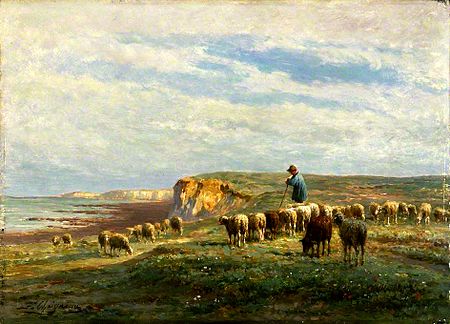
Ferdinand Chaigneau -Troupeau de moutons. A typical pastoral scene that initially defined the early villanelle.
A villanelle (also known as villanesque) is a nineteen-line poetic form consisting of five tercets followed by a quatrain. There are two refrains and two repeating rhymes, with the first and third line of the first tercet repeated alternately until the last stanza, which includes both repeated lines. The villanelle is an example of a fixed verse form. The word derives from Latin, then Italian, and is related to the initial subject of the form being the pastoral.
The form started as a simple ballad-like song with no fixed form; this fixed quality would only come much later, from the poem "Villanelle (J'ay perdu ma Tourterelle)" (1606) by Jean Passerat. From this point, its evolution into the "fixed form" used in the present day is debated. Despite its French origins, the majority of villanelles have been written in English, a trend which began in the late nineteenth century. The villanelle has been noted as a form that frequently treats the subject of obsessions, and one which appeals to outsiders; its defining feature of repetition prevents it from having a conventional tone.
Villanelles by Andy terry
Click here to read some Villanelles by Andy Terry
To the right, Dylan Thomas, Sylvia Plath and W.H. Auden
Famous villanelle poets


Dyland Thomas Sylvia Plath WH Auden